
Database: The Backbone of Modern Digital Systems in 2026
Introduction: Why Databases Matter More Than Ever
In 2026, databases are no longer just storage systems they are the foundation of nearly every digital experience. From mobile apps and websites to AI systems, cloud platforms, fintech services, and enterprise software, everything depends on how efficiently data is stored, managed, and accessed.
As businesses generate massive volumes of data every second, the role of modern databases has evolved. Today’s databases are built for speed, scalability, security, and intelligence, enabling real-time decisions and powering advanced technologies like artificial intelligence and machine learning.
Without a well-structured database, even the most advanced software systems fail to perform reliably.
What Is a Database?
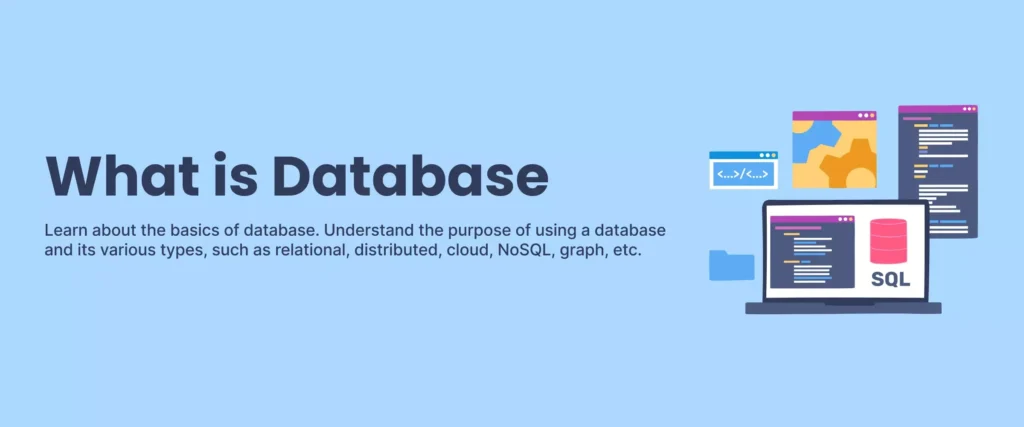
A database is an organized collection of structured or unstructured data that is stored electronically and accessed through software systems. It allows data to be:
- Stored securely
- Retrieved quickly
- Updated efficiently
- Scaled as demand grows
Modern databases are designed to handle millions (or billions) of records while maintaining performance, accuracy, and availability.
Evolution of Database Technology (Past to 2026)
Database systems have changed dramatically over the years:
- Traditional Databases: Used static tables and local servers
- Relational Databases: Introduced structured schemas and SQL
- NoSQL Databases: Enabled flexibility for unstructured data
- Cloud Databases: Removed hardware dependency
- AI-Optimized Databases (2026): Support real-time analytics and automation
In 2026, databases are no longer passive storage units. They actively support data analytics, AI models, and predictive systems.
Types of Databases Used in 2026
1. Relational Databases
Used for structured data with fixed schemas.
Examples:
- MySQL
- PostgreSQL
- Oracle Database
Best for:
- Financial systems
- Enterprise applications
- Transaction-based platforms
2.NoSQL Databases
Designed for flexibility and large-scale applications.
Examples:
- MongoDB
- Cassandra
- Redis
Best for:
- Big data applications
- Social media platforms
- Real-time web apps
3.Cloud Databases
Hosted and managed on cloud infrastructure.
Key advantages:
- Automatic scaling
- High availability
- Reduced maintenance
Popular use cases:
- SaaS platforms
- E-commerce systems
- Global applications
4.AI & Vector Databases
Used to support AI models, embeddings, and semantic search.
Why they matter:
- Power chatbots and AI assistants
- Enable fast similarity searches
- Support machine learning workflows
Why Databases Are Critical for Businesses in 2026
Modern businesses rely on databases to:
- Make data-driven decisions
- Improve customer experience
- Store sensitive user information securely
- Analyze trends in real time
- Support automation and AI systems
A poorly designed database can cause:
- Slow applications
- Security vulnerabilities
- Data loss
- Scalability issues
A strong database architecture, on the other hand, gives companies a competitive edge.
Database Security and Privacy in 2026
With stricter global data regulations, database security is a top priority.
Modern database security includes:
- End-to-end encryption
- Role-based access control
- Automated backups
- Real-time threat detection
- Compliance with data protection laws
In 2026, databases are built with security-by-design, not as an afterthought.
Database Performance Optimization
To meet modern demands, databases must be optimized for:
- High-speed queries
- Low latency
- Concurrent user access
- Large datasets
Performance techniques include:
- Indexing strategies
- Query optimization
- Caching layers
- Load balancing
- Horizontal and vertical scaling
Role of Databases in AI, Big Data, and Automation
Databases play a central role in:
- Artificial Intelligence: Training and storing AI models
- Big Data Analytics: Processing massive datasets
- Automation: Powering workflows and intelligent systems
In 2026, databases are tightly integrated with AI pipelines, enabling systems to learn, adapt, and respond in real time.
Future of Databases Beyond 2026
The future of databases points toward:
- Self-healing databases
- Fully autonomous database management
- AI-driven query optimization
- Serverless database architectures
- Deeper integration with edge computing
Databases will continue evolving from data storage tools into intelligent decision engines.
Conclusion: Database as a Strategic Asset
In 2026, a database is not just a technical component it’s a strategic business asset. Organizations that invest in modern, scalable, and secure database systems gain better insights, faster performance, and long-term stability.
Whether you’re building an app, managing enterprise software, or developing AI-driven platforms, the right database architecture defines success.